Sidebar

 Français
  Español
SINAPS Consult Blog's
Five key points for an optimal risk assessment of your production structure

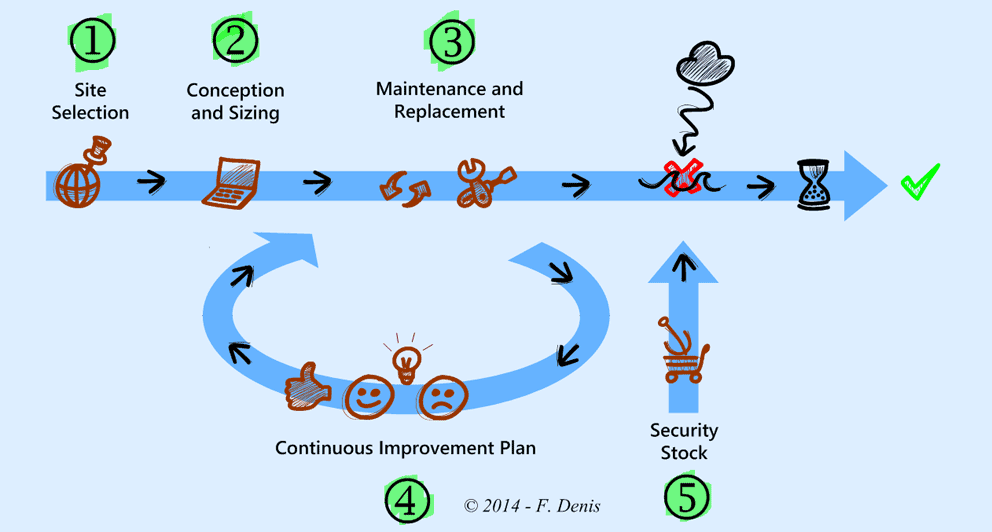
Risk assessment needs an ongoing effort that starts from the origin of the project. Here we are talking about the five main levers which allow to control the risk on production structures.
1. The choice of the production site and farming structures
Risk assessment needs to be undertaken at the very beginning of the project. A relevant choice of the production site in keeping with the selected farming structure will be key to lower the risk and increase the sustainability of the project. The choice of the production site is further crucial as it is irreversible.
2. Conception and sizing
Concession layout as well as the design and sizing of the mooring system must be reasonable and associated with technical solutions allowing their implementation. It is usually accepted that current data that will be used as input for a proper sizing of the project are actually maximal currents recorded over a 10 year period. Similarly, swell and wave data to be taken into account are maximal values for significant height recorded over a 50 year period. Such data are often not available at a given farming site, or only available at a neighbouring site but for insufficient period of time.
It will be thus required to use mathematical modelling that will allow estimating offshore swell and currents from wind forces obtained from isobaric charts. Data for a specific production site will be subsequently extrapolated by combining these offshore estimates with bathymetric and coastline data.
It is however quite challenging to anticipate whether an exposed site with long-time recorded data is actually less or more suitable than an apparently less exposed site for which scarce data is available.
We can still assume that:
- The specific risk associated with an exposed site will be assessed through a proper sizing of the production structure.
- The specific risk associated with an unknown site will require a higher safety factor.
3. Maintenance and replacement
We know that design and sizing of a mooring system does not fully prevent damage at a long time scale. However, if we do want to maintain the risk at its initial level, we need to carry out proper maintenance and constantly be able to replace used parts. Maintenance and parts replacement will be considered as optimal if they allow all parts of the system to be maintained at a level of wear that is compatible with the safety factors used during the initial sizing of the whole production system. It is important to note that there is always one specific component that can be considered as the weak link, which is obviously important to identify.
4. Continuous Improvement Plan
The scarcity of meteorological data, the relevance of mathematical models together with the forecasted climate change highlights the need for a constant adaptation/improvement of the production structure to the actual field conditions. In other words, it is compulsory to properly size and design the production structure but it is as important to adapt it to the reality of the field.
5. Security stock
Finally, in case of infrastructure damage, the risk of loss will be proportionated to the time required for repair. Of course, the knowledge of the intervention team will allow shortening the crucial repair step provided parts are rapidly accessible. Therefore an important spare part stock, hereafter named security stock will be a main driver of the risk level. Security stock is thus crucial for limiting risk, and the minimal threshold of this stock should be regularly re-evaluated.
Conclusion
The choice of a given production site should not force the production team and infrastructures to work close to their maximum capacities. The sizing of the infrastructures should warranty a proper functioning as long as the conditions are close to those anticipated. Maintenance must prevent the production structure from losing its resistance under a known threshold. Each new cycle of improvement will lower the risk by adapting the production structure to the reality of the field. Finally, a relevant security stock will optimize the intervention capacities of the production team.
If you are willing to evaluate your structure and lower your risk, feel free to contact SINAPS Consult!
Copyright
© 2014 - F.Denis
About the author

Comments
Categories